Sur cette page
Packaging is not just a finishing detail in bulk matcha sourcing. For B2B buyers, it directly affects freshness, shelf life, logistics cost, product presentation, MOQ, and customer experience.
Matcha powder is sensitive to light, heat, moisture, oxygen, and odor. If packaging is not selected properly, even a good matcha grade can lose color, aroma, and flavor before it reaches the end user.
This guide explains how cafés, distributors, food manufacturers, beverage brands, supplement companies, and private label brands should choose matcha packaging for bulk supply and commercial use.
Why Packaging Matters in Bulk Matcha Sourcing
Matcha is a fine green tea powder. Compared with many dry ingredients, it is more sensitive to environmental factors. Poor packaging can lead to dull color, weaker aroma, clumping, oxidation, and reduced shelf appeal.
For B2B buyers, packaging affects several business decisions:
- How long the matcha can stay fresh
- How easy it is to store and handle
- How much shipping volume and weight you pay for
- Whether the product is suitable for retail or foodservice
- Whether the packaging matches your brand positioning
- Whether MOQ and lead time are realistic for your project
A café may need practical 1kg foodservice bags. A distributor may prefer bulk cartons. A private label brand may need printed pouches or tins. A supplement brand may require sachets or stick packs.
Before choosing packaging, buyers should first define how the product will be used.
Start with the Business Model
The best matcha packaging depends on the buyer’s business model. A packaging format that works well for one buyer may not be suitable for another.
Cafés and Coffee Shops
Cafés usually need packaging that is easy to open, reseal, store, and use during daily service.
Common options include:
- sacs de 500 g
- Sacs en papier d'aluminium de 1 kg
- Foodservice pouches
- Resealable bulk bags
The packaging should protect freshness while remaining practical for baristas. For cafés, convenience is often more important than luxury presentation.
Distributors and Wholesalers
Distributors often care about storage efficiency, carton strength, batch labels, and repeat supply.
Common options include:
- 1kg foil bags packed in cartons
- 5kg bulk bags
- 10kg cartons
- Export-ready master cartons
For distributors, packaging should be easy to warehouse, identify, and resell to different customer groups.
Food and Beverage Manufacturers
Food manufacturers usually need efficient packaging for production handling.
Common options include:
- 5kg or 10kg bulk bags
- Larger food-grade cartons
- Inner liner bags
- Batch-labeled cartons
The focus is usually on production efficiency, ingredient protection, and cost control.
Marques de distributeur
Marque de distributeur brands need packaging that supports both product quality and brand identity.
Common options include:
- Sachets à fond plat
- Flat-bottom pouches
- Boîtes de conserve
- Pots
- Sachets
- Sachets individuels
- Coffrets cadeaux
For private label products, packaging design, shelf appeal, label information, and MOQ become much more important.
Main Packaging Formats for Matcha Powder
Different packaging formats have different cost, MOQ, freshness, and branding advantages.
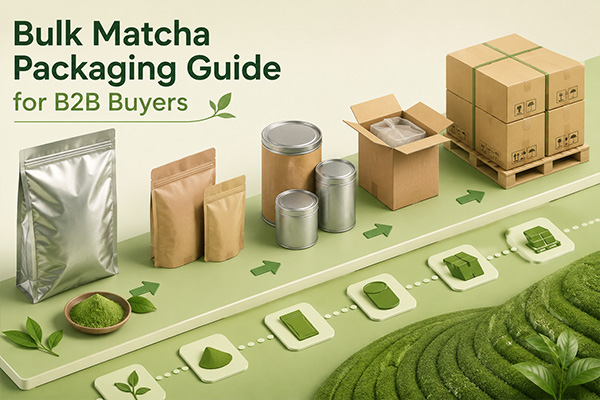
| Format de l'emballage | Meilleur pour | Advantages | Considerations |
|---|---|---|---|
| sachet en papier d'aluminium de 1 kg | Cafés, restauration, petit commerce de gros | Good freshness protection, flexible, practical | Less premium for retail |
| 5kg / 10kg bulk bag | Manufacturers, distributors | Lower cost per kg, efficient handling | Not suitable for direct retail |
| Sachet à fond plat | Private label, e-commerce, retail | Good shelf appeal, flexible sizes | Printed packaging may require higher MOQ |
| Flat-bottom pouch | Premium retail brands | Better shelf presence | Coût d'emballage plus élevé |
| Boîte de conserve | Premium matcha, gifting, retail | Strong premium image, good protection | Higher cost and shipping volume |
| Sachet en forme de bâtonnet / sachet | Samples, single-serve, travel format | Pratique et en portions contrôlées | Higher filling cost and packaging MOQ |
| Paper box + inner pouch | Gift sets, premium retail | Strong brand presentation | More components and longer lead time |
There is no single “best” packaging format. The right choice depends on whether your priority is freshness, cost, branding, portability, or production efficiency.
Packaging Materials: What B2B Buyers Should Understand
For matcha, packaging material matters because it protects the powder from light, air, moisture, and odor.
Aluminum Foil Bags
Aluminum foil bags are commonly used for bulk matcha because they provide good barrier protection. They are suitable for cafés, foodservice, wholesale, and ingredient use.
They help protect against:
- Light
- Oxygen
- Humidité
- External odor
Kraft Paper Pouches
Kraft paper pouches can create a natural or organic look, but they usually need an inner barrier layer to protect matcha properly.
They are often used for:
- Organic product positioning
- Natural food brands
- Retail pouches
- Produits en marque de distributeur
Plastic Barrier Pouches
Plastic barrier pouches can be lightweight and flexible. They may be used for retail or foodservice packaging, depending on the barrier structure.
Buyers should confirm whether the packaging has enough protection for matcha’s shelf life requirements.
Metal Tins
Tins provide a premium look and good physical protection. They are often used for high-end matcha, ceremonial matcha, retail products, and gift packaging.
However, tins increase:
- Coût de l'emballage
- Volume d'expédition
- MOQ
- Délai de livraison
Stick Pack Film
Stick packs require suitable film material, sealing performance, and filling-line compatibility. They are useful for single-serving matcha, travel packs, trial packs, or wellness product formats.
Matcha Packaging by Net Weight
Choosing the right net weight is important for both customer experience and cost planning.
Common Bulk and Retail Sizes
| Net Weight | Common Use |
|---|---|
| 30g | Premium retail, ceremonial trial size |
| 50g | Sachet ou boîte de vente au détail |
| 100g | E-commerce, private label, home use |
| 250g | Small foodservice or retail value pack |
| 500g | Café and foodservice use |
| 1 kg | Cafés, distributors, wholesale buyers |
| 5kg | Food manufacturing and bulk ingredient use |
| 10kg | Large-volume production and distribution |
How to Choose Net Weight
Posez-vous la question suivante :
- Who will use the product?
- How quickly will the product be consumed after opening?
- Is the product for retail, foodservice, or production?
- Does the package need to look premium?
- Will shipping cost increase because of packaging volume?
- Does the packaging size match your MOQ and sales plan?
For cafés, 1kg bags are often practical. For retail brands, 50g or 100g pouches may be easier to position. For food factories, 5kg or 10kg packaging is more efficient.
Bulk Packaging vs Retail Packaging
Bulk packaging and retail packaging have different goals.
Conditionnement en vrac
Bulk packaging focuses on protection, efficiency, and cost control.
Il convient pour :
- Cafés
- Restauration
- Acheteurs de matières premières
- Manufacturers
- Distributeurs
- Repacking companies
Key priorities include:
- Barrier protection
- Strong cartons
- Batch labels
- Easy warehouse handling
- Lower cost per kg
Emballages destinés à la vente au détail
Retail packaging focuses on branding, shelf appeal, consumer trust, and ease of use.
Il convient pour :
- Marques privées
- Vendeurs en ligne
- Marques d'alimentation bio
- Premium retail products
- Marques de bien-être
Key priorities include:
- Visual design
- Label information
- Easy opening and resealing
- Consumer-friendly net weight
- Une allure haut de gamme
Comparaison pratique
| Factor | Conditionnement en vrac | Emballages destinés à la vente au détail |
|---|---|---|
| Objectif principal | Protection and efficiency | Branding and customer experience |
| Coût | Moins cher au kilo | Higher per unit |
| MOQ | Généralement plus bas | May be higher |
| Lead Time | Plus court | Plus long |
| Design Need | Simple label or carton mark | Full artwork and label review |
| Meilleur pour | B2B handling | Consumer-facing sales |
Private Label Matcha Packaging Options
Private label buyers should think about packaging as part of the product strategy, not only as a container.
Stand-Up Pouch
This is one of the most common options for private label matcha. It is flexible, lightweight, and suitable for different net weights.
Idéal pour :
- Marques de commerce électronique
- Retail pouches
- Matcha bio
- Marques d'aliments fonctionnels
- Value packs
Tin Can
Tin packaging gives a more premium feeling. It is suitable for ceremonial matcha, gift products, and premium retail positioning.
Idéal pour :
- High-end matcha
- Coffrets cadeaux
- Premium cafés
- Retail shelves
Sachet or Stick Pack
Sachets and stick packs are convenient for sampling, travel, single-serving use, or powder blends.
Idéal pour :
- Packs d'essai
- Functional drink powders
- Café portion control
- Boîtes d'abonnement
- Marques de bien-être
Gift Box or Kit
Gift packaging can include matcha powder, whisk, spoon, bowl, or other accessories.
Idéal pour :
- Commerce de détail haut de gamme
- Seasonal gift sets
- Offres groupées de commerce électronique
- Brand storytelling
Packaging MOQ: Why It Is Often Different from Powder MOQ
One common mistake is assuming the powder MOQ and packaging MOQ are the same.
They are often different.
For example, a supplier may support a lower MOQ for bulk matcha powder, but custom printed pouches may require a higher minimum order from the packaging factory.
Common MOQ Factors
Packaging MOQ may depend on:
- Packaging material
- Printing method
- Pouch size
- Number of colors
- Tin mold availability
- Label printing quantity
- Stick pack film MOQ
- Box or carton customization
- Filling and sealing setup
Practical Packaging MOQ Table
| Packaging Type | MOQ Pressure | Remarques |
|---|---|---|
| Standard foil bag | Inférieur | Good for first orders and foodservice use |
| Pochette de stock avec étiquette autocollante | Faible à moyen | Idéal pour le lancement de petites marques de distributeur |
| Pochette imprimée sur mesure | Moyen à élevé | Better branding, higher setup requirement |
| Boîte de conserve | Moyen à élevé | Depends on tin size, printing, and stock availability |
| Sachet en forme de bâtonnet | Plus élevé | Requires film and filling-line setup |
| Coffret cadeau | Plus élevé | More components and longer preparation time |
For new brands, it may be smarter to begin with stock packaging and custom labels before moving into fully printed packaging.
Label Information Buyers Should Prepare
For private label matcha, packaging design should not only look attractive. It also needs the right product information.
Common Label Elements
Buyers may need to prepare:
- Nom du produit
- Poids net
- Liste des ingrédients
- Déclaration d'origine
- Informations nutritionnelles
- Consignes de conservation
- Zone réservée à la date limite de consommation
- Zone du numéro de lot
- Code-barres
- Informations sur l'importateur ou le distributeur
- Organic logo or certification details, if applicable
- Preparation instructions
- Warning or allergen statement if required by market
Why Label Review Matters
Incorrect label information can delay production, cause customs issues, or create retail compliance problems.
Before printing packaging, B2B buyers should confirm:
- Target market requirements
- Language requirements
- Organic labeling rules
- Nutrition panel format
- Claim wording
- Barcode and company details
For private label projects, label review should happen before mass packaging production.
Packaging and Shelf Life
Packaging plays a major role in matcha shelf life. Even if the powder is high quality, poor packaging can reduce freshness.
What Packaging Should Protect Against
Matcha packaging should help reduce exposure to:
- Light
- Chaleur
- Humidité
- Oxygen
- Odor
- Frequent opening
Storage-Related Packaging Questions
Before choosing packaging, ask:
Does the packaging block light?
Does it have a good moisture barrier?
Is it resealable after opening?
Is the material suitable for food contact?
How long can the product remain fresh after opening?
Is the packaging suitable for warehouse storage?
Packaging for Opened Products
For cafés and foodservice buyers, opened packaging matters. Staff may open and close bags many times per day. A resealable zipper, proper scoop handling, and storage instructions can help protect quality.
For retail customers, easy resealing improves the customer experience and reduces complaints about clumping or flavor loss.
Packaging and Shipping Efficiency
Packaging also affects logistics cost. A premium tin may look attractive but takes more space than a pouch. A gift box may improve retail value but increase carton volume.
Shipping Factors to Consider
B2B buyers should check:
- Net weight per unit
- Gross weight per carton
- Dimensions du carton
- Carton strength
- Pallet loading
- Shipping method
- Destination warehouse handling
- Risk of crushing or leakage
Packaging Format and Shipping Impact
| Format de l'emballage | Shipping Efficiency |
|---|---|
| Bulk foil bag | Élevé |
| 5kg / 10kg carton | Élevé |
| Sachet à fond plat | Moyen à élevé |
| Boîte de conserve | Moyen |
| Sachet en forme de bâtonnet | Moyen |
| Coffret cadeau | Lower, depending on structure |
For distributors and importers, carton design and pallet planning can be just as important as the retail pack itself.
Packaging for Different Matcha Applications
Different applications require different packaging thinking.
Matcha for Cafés
Café packaging should be easy to store, open, reseal, and use during daily drink preparation.
Recommended focus:
- 500g or 1kg bags
- Good resealing
- Clear grade label
- Numéro de lot
- Consignes de conservation
Matcha for Food Manufacturing
Food manufacturers usually prefer larger packaging for production efficiency.
Recommended focus:
- 5kg or 10kg bags
- Strong outer carton
- Clear batch identification
- Easy warehouse handling
- Lower packaging cost per kg
Matcha for Retail Brands
Retail brands need packaging that supports shelf appeal and customer trust.
Recommended focus:
- Attractive design
- Clear label information
- Good barrier material
- Easy resealing
- Suitable net weight
Matcha for Supplement and Wellness Brands
Supplement and wellness brands may use matcha in blends, sachets, capsules, or functional powders.
Recommended focus:
- Contrôle de l'humidité
- Écoulement de poudre
- Sachet compatibility
- Clear ingredient labeling
- Clean-label presentation
Common Packaging Mistakes B2B Buyers Should Avoid
Mistake 1: Choosing Packaging Only by Appearance
Attractive packaging is important, but matcha also needs strong protection from light, moisture, oxygen, and heat.
Erreur n° 2 : ne pas tenir compte de la quantité minimale de commande (MOQ) pour les emballages
Custom packaging may have a higher MOQ than the powder itself. This should be confirmed early.
Mistake 3: Selecting Tins Without Calculating Shipping Volume
Tins can create a premium image, but they also increase shipping volume and cost.
Mistake 4: Printing Packaging Before Label Review
Packaging artwork should be reviewed before printing, especially for organic claims, nutrition panels, importer information, and market-specific language.
Mistake 5: Using the Same Packaging for Every Channel
Café, retail, distributor, and manufacturing channels often need different packaging formats.
Mistake 6: Forgetting Opened-Pack Storage
Once a bag is opened, freshness depends on resealing and storage. Packaging should support real customer usage.
Bulk Matcha Packaging Decision Checklist
Use this checklist before confirming packaging for your matcha order.
| Zone | Ce qu'il faut vérifier |
|---|---|
| Business model | Café, distributor, manufacturer, private label, retail |
| Product application | Latte, bakery, RTD, supplement, retail pouch |
| Poids net | 30g, 50g, 100g, 500g, 1kg, 5kg, 10kg |
| Packaging type | Foil bag, pouch, tin, sachet, carton, gift box |
| Barrier protection | Light, moisture, oxygen, odor protection |
| Label information | Ingredients, net weight, storage, batch, barcode |
| MOQ | Quantité minimale de commande (QMC) pour la poudre et pour l'emballage |
| Délai de livraison | Packaging production, filling, sealing, packing |
| Durée de conservation | Whether packaging supports expected freshness |
| Logistique | Carton size, weight, pallet, shipping method |
| Budget | Packaging cost and total landed cost |
| Positionnement de la marque | Basic, foodservice, premium, organic, private label |
How MatchaOEMFactory Supports Matcha Packaging Projects
MatchaOEMFactory supports B2B buyers with bulk matcha powder, wholesale packaging, private label packaging, and custom matcha solutions.
We help buyers choose packaging based on product application, target market, MOQ, budget, and brand positioning. Whether you need bulk foil bags for cafés, large cartons for food manufacturing, retail pouches for private label products, or premium tins for branded matcha, our team can help you compare practical options.
Notre assistance comprend :
- Bulk matcha packaging
- Foodservice packaging options
- Private label pouch and tin packaging
- Label and artwork coordination
- Recommandations concernant la taille des emballages
- Planification des quantités minimales de commande (MOQ)
- Export carton support
- Sample and quotation preparation
By planning packaging early, buyers can reduce sourcing risk, control cost, and create a better product experience from storage to final use.
Foire aux questions
What is the best packaging for bulk matcha powder?
For bulk use, aluminum foil bags and export cartons are commonly used because they offer practical protection and efficient handling.
What packaging is best for private label matcha?
Stand-up pouches, tins, sachets, and gift boxes are common private label options. The best choice depends on your brand positioning, MOQ, target market, and budget.
Is custom printed packaging necessary for a first order?
Not always. New brands can often start with stock packaging and custom labels to reduce MOQ and test the market before investing in fully printed packaging.
Does packaging affect matcha shelf life?
Yes. Matcha is sensitive to light, moisture, oxygen, heat, and odor. Good barrier packaging helps protect color, aroma, and flavor.
Why is packaging MOQ sometimes higher than matcha powder MOQ?
Packaging materials, especially printed pouches, tins, stick pack films, or boxes, often have their own production MOQ from packaging suppliers.
Should cafés use retail packaging or foodservice packaging?
Foodservice packaging is usually more practical for cafés because it is easier to use daily and often more cost-effective than small retail packs.
Ready to Choose the Right Packaging for Your Matcha Project?
The right packaging can protect matcha quality, support your brand image, reduce logistics problems, and make your sourcing project easier to manage.
MatchaOEMFactory helps cafés, distributors, food and beverage brands, supplement companies, and private label businesses choose practical matcha packaging for bulk supply, retail launch, and custom OEM projects.
Share your application, target market, expected quantity, and preferred packaging format. Notre équipe can help you compare options and prepare a tailored quotation.