Sur cette page
Sourcing matcha powder from China can be a practical option for cafés, food and beverage brands, distributors, supplement companies, and private label businesses that need stable supply, flexible grades, competitive pricing, and OEM packaging support.
China has a mature tea-growing and food manufacturing supply chain, making it suitable for commercial matcha applications such as lattes, bakery products, desserts, ready-to-drink beverages, functional powders, and private label retail packs. However, successful sourcing requires more than finding the lowest price. Buyers need to understand origin, grade, processing, documents, packaging, logistics, and supplier communication before placing a bulk order.
Understand Why Buyers Source Matcha from China
Many B2B buyers source matcha powder from China because they need a balance of quality, supply stability, cost control, and product development flexibility.
China-sourced matcha can be especially suitable for:
- Café chains and beverage shops
- Food and beverage manufacturers
- Bakery and dessert brands
- Bubble tea and RTD beverage brands
- Supplement and wellness product companies
- Marques de matcha en marque de distributeur
- Distributors and importers
- OEM and custom packaging projects
For many commercial applications, buyers do not always need the most expensive ceremonial matcha. A well-selected Chinese matcha grade can work well for lattes, desserts, bakery products, superfood blends, and bulk food manufacturing.
Define Your Product Use Before Asking for a Quote
Before contacting a supplier, define exactly how you plan to use the matcha. This makes the sourcing process faster and helps the supplier recommend the right grade.
You should prepare answers to these questions:
Quel produit fabriquez-vous ?
Is it for lattes, bakery, RTD drinks, supplements, or retail packs?
Do you need organic matcha?
Do you need bulk powder or private label packaging?
What is your target market?
Quelle est la quantité estimée de votre commande ?
Do you need documents for import or retail listing?
A buyer sourcing matcha for iced lattes may need a different grade from a buyer making matcha cookies, capsules, or private label tins. Without a clear application, suppliers may only quote a general grade, which may not perform well in your final product.
Know the Main Types of Chinese Matcha Supply
When sourcing from China, buyers may encounter different supply models. Understanding these models helps you avoid confusion during negotiation.
| Supply Type | Meilleur pour | Remarques |
|---|---|---|
| Bulk powder supply | Importers, food factories, cafés | Usually packed in foil bags or cartons |
| Matcha en gros | Distributors, foodservice buyers | Suitable for repeat B2B orders |
| Matcha en marque de distributeur | Retail and e-commerce brands | Includes packaging and label support |
| Mélanges de matcha sur mesure | Beverage, supplement, and food brands | May include flavor, color, or application adjustment |
| Organic matcha supply | Premium and clean-label brands | Requires certification and document confirmation |
For a new brand, private label supply may be more suitable than buying raw bulk powder only. For food manufacturers, bulk cartons or large bags are often more practical. For cafés, 1kg bags or foodservice pouches may be easier to manage.
Shortlist Suppliers by Capability, Not Just Price
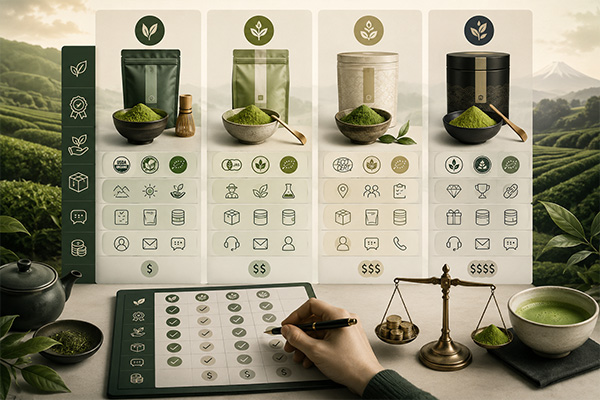
When you start searching for matcha suppliers in China, you may find many trading companies, factories, exporters, and OEM service providers. Instead of comparing only price, build a supplier shortlist based on practical capability.
A good shortlist should include suppliers that can provide:
- Suitable matcha grades for your application
- Samples before bulk ordering
- Clear packaging options
- COA and specification sheet
- Export experience
- Stable communication
- Private label or OEM support if needed
- Reasonable MOQ and lead time
- Batch control and repeat supply support
For sourcing from China, communication quality matters a lot. A professional supplier should ask about your application, market, packaging, and target quality before quoting. If a supplier only sends a low price without asking questions, you may need to be careful.
Request Samples and Test Them in Real Applications
Sampling is one of the most important steps when sourcing matcha powder from China. Do not evaluate matcha only by looking at dry powder.
Test the sample in the way your customer will actually use it:
| Your Product | How to Test the Matcha |
|---|---|
| Café latte | Test with hot milk, iced milk, oat milk, and sweetened formulas |
| Boulangerie | Test color after baking and flavor after heating |
| boisson prête à boire | Test suspension, sedimentation, color change, and taste over time |
| Complément alimentaire en poudre | Test blending, color, taste, and packaging stability |
| Sachet destiné à la vente au détail | Test taste, appearance, aroma, and customer positioning |
For cafés and beverage brands, milk compatibility is especially important. Some matcha looks good in water but becomes dull, bitter, or weak when mixed with milk. For bakery and dessert products, heat stability and flavor strength matter more than ceremonial smoothness.
Confirm Documents Before Confirming the Order
For international B2B sourcing, documentation should be confirmed before production or bulk shipment. This is especially important for importers, distributors, organic brands, and private label companies.
Common documents may include:
ACO
Fiche technique
Informations relatives aux essais microbiologiques
Informations relatives aux analyses de métaux lourds
Informations sur les résidus de pesticides
Certificat de production biologique, le cas échéant
Liste des affaires à emporter
Facture commerciale
Label information
Durée de conservation et conditions de stockage
For organic matcha, buyers should confirm which organic standard is needed for their market. China Quality Certification Centre explains that organic product certification typically involves application review, document review, on-site inspection, sampling and analysis, certification decision, certificate issuance, and post-certification supervision.
If you plan to sell organic matcha in the U.S. or EU, check the destination-market requirements as well. USDA states that organic certification verifies compliance with USDA organic regulations, while the European Commission explains that use of the Produits biologiques de l'UE logo requires certification by an authorized control body.
Discuss Packaging Early
Packaging should not be discussed at the last minute. It affects MOQ, lead time, cost, shelf life, shipping volume, and brand presentation.
Common sourcing options include:
- Bulk foil bags
- Foodservice pouches
- 1kg bags
- 5kg or 10kg cartons
- Retail stand-up pouches
- Metal tins
- Sachets individuels
- Sachets
- Private label kits
If you need custom printing, the packaging MOQ may be higher than the matcha MOQ. If you use ready-made packaging with a label sticker, the launch process may be faster and more flexible for small orders.
For private label projects, confirm these details early:
Bag size
Poids net
Label design
Code-barres
Tableau nutritionnel
Liste des ingrédients
Consignes de conservation
Durée de conservation
Emballage en carton
Outer box marks
Understand MOQ, Lead Time, and Production Planning
MOQ can vary depending on grade, packaging, certification, and customization. Bulk powder orders are usually easier to arrange than fully customized retail packaging.
A typical sourcing timeline may include:
| Étape | Que se passe-t-il ? |
|---|---|
| Inquiry | Buyer shares application, quantity, market, and packaging needs |
| Grade recommendation | Supplier suggests suitable matcha options |
| Sampling | Buyer tests samples in real application |
| Packaging confirmation | Bulk or private label packaging is selected |
| Quotation | Price, MOQ, lead time, and shipping terms are confirmed |
| Production | Matcha is prepared, packed, and inspected |
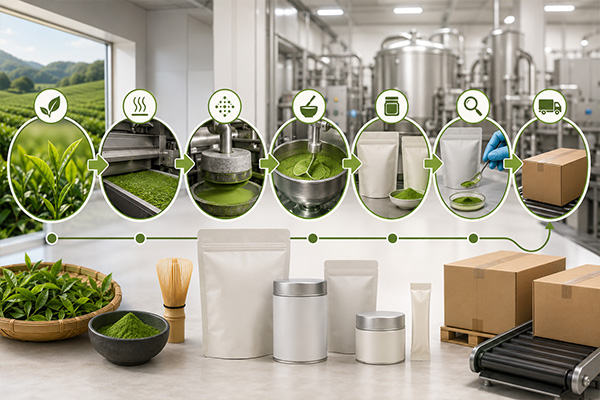
| Documentation | COA, packing list, invoice, and other documents are prepared |
| Livraison | Goods are delivered to forwarder or arranged for export |
For new buyers, starting with samples and a practical first order is usually better than placing a large order without testing.
Plan Shipping and Import Communication
When sourcing from China, buyers should clarify shipping terms early. Some buyers use their own freight forwarders, while others ask the supplier to help with air, sea, express, or door-to-door shipping options.
Before shipment, confirm:
Shipping method
Carton size and weight
Total gross weight
Number of cartons
Lead time to forwarder
Export document requirements
Destination import requirements
Temperature or storage concerns
Batch photos before shipment
For food products, import rules may vary by country and product category, so buyers should check destination-market requirements with local import agents or regulatory consultants. China Customs provides official information related to the safety supervision of imported and exported foods, which can be used as a reference point for understanding the broader regulatory environment.
Avoid Common Sourcing Mistakes
Many problems in matcha sourcing happen because buyers move too quickly from price inquiry to bulk order.
Common mistakes include:
Choosing only by lowest price
Not testing samples in the real formula
Ignoring packaging MOQ
Not confirming documents early
Using the wrong grade for the application
Not checking batch consistency
Confusing ceremonial quality with commercial suitability
Forgetting shipping cost and import requirements
Approving packaging before confirming local labeling rules
A better sourcing process is slower at the beginning but faster later. When grade, packaging, documents, and logistics are clear from the start, repeat orders become much easier.
China Matcha Sourcing Checklist
Use this checklist before placing a bulk order:
| Sourcing Item | Confirm Before Order |
|---|---|
| Application | Latte, bakery, RTD, supplement, retail, foodservice |
| Grade | Ceremonial, latte, culinary, ingredient grade, organic |
| Sample test | Tested in real product formula |
| Documents | COA, specification, certificates, invoice, packing list |
| Emballage | Bulk bag, carton, pouch, tin, sachet, private label |
| MOQ | Quantité minimale de commande (QMC) pour la poudre et pour l'emballage |
| Prix | Product price, packaging cost, shipping cost |
| Délai de livraison | Sample, production, packaging, delivery |
| Logistique | Forwarder, shipping method, destination requirements |
| Commande renouvelée | Batch consistency and long-term availability |
How MatchaOEMFactory Supports China Matcha Sourcing
MatchaOEMFactory helps B2B buyers source matcha powder from China for bulk supply, wholesale distribution, food manufacturing, café applications, wellness products, and marque de distributeur brands.
We can support your sourcing process with:
- Recommandations concernant la qualité du matcha en fonction de l'utilisation prévue
- Fourniture de poudre de matcha en vrac
- Latte, culinary, ingredient-grade, ceremonial, and organic options
- Fourniture d'échantillons avant les commandes en gros
- Prise en charge des certificats d'origine et des spécifications
- Options d'emballage pour les marques de distributeur
- Développement de produits personnalisés à base de matcha
- Documentation prête à l'exportation
- Coordination des expéditions et de la logistique
Whether you are developing a café menu, sourcing matcha for food production, launching a private label brand, or building a wholesale matcha supply chain, notre équipe can help you compare grades, test samples, and plan a practical sourcing solution.
Foire aux questions
Is Chinese matcha suitable for commercial use?
Yes. Chinese matcha can be suitable for lattes, bakery, desserts, RTD beverages, supplements, private label packaging, and food manufacturing when the correct grade is selected and tested properly.
Is Chinese matcha the same as Japanese matcha?
Not always. Origin, cultivar, growing method, processing, grinding, taste, color, and price can differ. B2B buyers should choose based on application, not only origin.
Can I source organic matcha from China?
Yes, organic matcha options may be available, but buyers should confirm the certificate type, issuing body, product scope, and destination-market requirements before ordering.
Should I buy bulk powder or private label matcha?
Bulk powder is suitable for manufacturers, distributors, and foodservice buyers. Private label matcha is better for retail brands, e-commerce brands, and companies launching finished consumer products.
What should I test before placing a bulk order?
Test color, taste, aroma, fineness, solubility, milk compatibility, heat stability, packaging suitability, and document availability.
Ready to Source Matcha Powder from China?
Looking to source matcha powder from China for your business?
MatchaOEMFactory provides bulk matcha powder, wholesale matcha, private label packaging, custom blending, and export-ready documentation for cafés, distributors, food and beverage brands, supplement companies, and OEM customers.
Tell us your application, target market, expected quantity, and packaging needs. Notre équipe can recommend suitable matcha grades, arrange samples, and provide a customized quotation for your project.